





From Seven Cats to 1,000: How One Volunteer Helped Fix a Stray Crisis


The sound coming from her neighbor’s yard was a desperate cry that Jackie Crawford couldn’t ignore. Underneath a shed, she found a kitten, frail and infested with fleas. Taking it home with her, Crawford nursed it back to health and prepared the small animal to be adopted through a local animal shelter.
This wasn’t the first time Crawford had found a feline life in danger on her street. Not long before, she had found another stray lying alone in the road of her Columbus, Ohio, neighborhood. It was one of the many cats she had seen that had been hit by car.
“There’s got to be a better solution to this,” she said about the overwhelming cat populations in her community. “Where are they coming from? What can we do about it?”
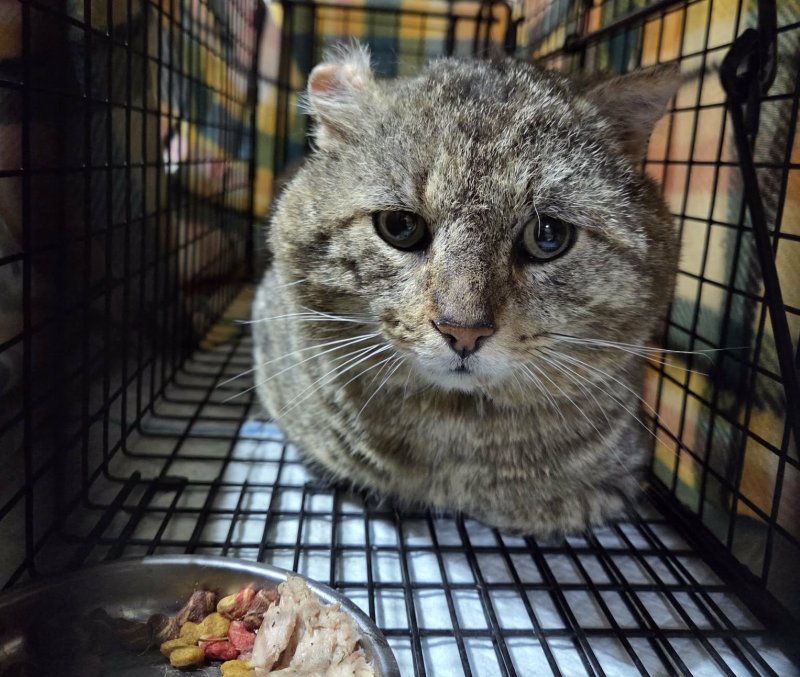
The solution she found was to start a Trap-Neuter-Return (TNR) program, a practice that she found online and would transform her from a concerned neighbor to a community hero. After discovering TNR towards the end of 2023, Crawford decided to set up a temporary feeding station in her own backyard to see how many cats she could draw in. A total of seven cats came.
She got them fixed and word started to spread around town.
“Someone in the neighborhood found out, and then they told somebody, and they told somebody. Next thing you know, I was trapping at a mobile home park for seniors,” she explained.
In December of 2023, Crawford launched her Facebook page “HT Community Cats and TNR” to educate her community about the work she is doing. On her page, she posts pictures of recently trapped cats, cats up for adoption, resources for feline care, and news surrounding cat welfare.
Two and a half years later, Crawford has gone from sterilizing seven cats to helping nearly 1,000.
“I started doing it, in my own neighborhood, in my own house,” the 44-year-old said. “...because I was tired of seeing adult cats getting hit by cars. I was just tired of finding dead cats on the road.”
Working with Columbus Pet Rescue and relying on the donations of other community members, Crawford has facilitated the help of 960 cats. Of those, 800 were part of the TNR program, a process of catching stray cats, having them surgically sterilized, and returning them to the outdoors to continue living their lives without reproducing.
This practice stabilizes stray cat populations while improving feline health and eliminating nuisance behavior like fighting, yelling, and spraying.
Crawford estimates that she spends over 50 hours a week doing TNR work and focuses all her energy on her volunteer services – preparing traps, coordinating rescues, driving to locations, waiting at the vet, and keeping detailed records of the cats in her care.
While the legwork of capturing and transporting cats often falls to Crawford and her husband, she is quick to point out that she cannot do this work all alone.
“The number one thing that I have to say is it takes a village to get this done,” she said. “Whether that means people donating funds or supplies. I have people who donate newspapers, and that’s all they donate. But I can’t do what I do without everybody kind of coming together.”
The average cost of a neuter is $30 a cat, a cost that can quickly add up especially when cats need extra medical care. Because she cannot bear the financial cost alone, Crawford relies on rescues and vets that will cover the cost of neuters.
As much as Crawford relies on animal rescues, they rely on her and volunteers like her.
“We could not function without [independent volunteers]. Once these street cats have been altered and returned to their neighborhood, we need to continue our care for these colonies,” Connie Dekker, secretary of Columbus Pet Rescue, wrote in an email.
She further explained that volunteers like Crawford are needed to maintain the health of stray cat colonies by feeding them, identifying new and/or unneutered cats, and taking cats to get neutered.
Community members can tell a cat has not been neutered by their ears. A cat that has been spayed or neutered by a vet will have one-fourth of an inch of their left ear cut.
The biggest obstacle Crawford faces isn’t the cats themselves, but the misconceptions held by “naysayers,” as Crawford calls them. She revealed that many people see feral cats as nuisances that should simply be taken somewhere else and not returned to the wild.
“My main question for them is…where is that magical somewhere else you want them to go?” Crawford said. “They can be taken for euthanasia, or they could be returned. But if they’re not friendly, there’s nowhere to go.”
TNR is considered the most effective and humane solution because it addresses what is called the “vacuum effect”. This occurs when cats are simply removed from a location, causing a void in resources. The void is quickly filled by new cats who take advantage of the available food and shelter, beginning the breeding cycle all over again. The TNR approach slows the birth rate of new kittens and provides a barrier that prevents other reproductive cats from moving into an area.
Crawford often hears suggestions of dumping cats off in the country or by rivers, myths she is quick to debunk with the authority of someone who has seen the consequences.
“If you dump them off by the river, there’s no source of food. They’re not going to survive eating birds and mice,” she explained. “I’ve trapped at a farmer’s house before…and she would really appreciate if you stop dumping your feral cats on her property, where the coyotes eat them, and she has to pick up their dead bodies.”
Dekker agrees that dumping is why our communities are seeing an overpopulation of cats.
“I believe this problem stems from humans that fail to alter care for their pets and then dump their animals, thinking they will be fine on their own,” she wrote.
“Domestic cats are not able to fend for themselves and live very long. They need committed volunteers to feed and alter them. If we can stop continuing growth of these colonies, the problem would solve itself in 15-20 years.”
The results of Crawford’s intervention are tangible. In South Bloomfield, she would work with Columbus Pet Rescue to tackle a colony of 100 cats spread across only four houses, her largest job yet. They successfully captured 95% of them. She is just now noticing changes in the community in both her neighbors and the animals.
She notes that the cats seem healthier as they are eating more post-sterilization. She explains that before, the cats were very thin and didn’t eat much, despite food being available, because they were overly controlled by their reproductive hormones.
She says that neighbors are happier because sterilized cats spray less and fewer cats means “less poop in the flower beds.” The shift she’s noticed in her own neighborhood is even more profound.
“Now, when we do have a litter that pops out kittens, we’re actually finding people are willing to take them in,” Crawford said. “Before, everybody was so overwhelmed [with cats]. The neighborhood as a whole is coming together to help these cats, and it's phenomenal to watch…now we're seeing people are living more harmoniously with the strays.”
When Crawford shows up to a big trapping call, she says the people almost always say that they never meant to get so many cats. She has empathy for people who start feeding one cat and end up with 20 because she knows people often don’t have the resources or the knowledge to care for cats.
“They just don’t have the resources to get these cats help. And that’s where I come in to try and figure out what I can do to help these cats without judgement.”
For people noticing and feeling overwhelmed by a growing colony in their neighborhood, Dekker urges them to take agency.
“Reach out for help sooner rather than later. Ignoring the problem or thinking someone else will step up will just make it worse. Prioritize and get the females spayed first if needed.” Dekker wrote.
Whether it is a barn in the country or a drug-littered homeless camp, Crawford keeps her eye on the goal: to help the cats. She believes the burden shouldn't rest solely on the shoulders of volunteers and non-profit shelters. She hopes to see a future where her "labor of love" is backed by official policy.
“I would love to see more cities, towns, townships, and government agencies that speak up and support TNR efforts,” Crawford said.
Until then, she will keep her traps ready and her newspapers stacked. For Crawford, the work has evolved into more than just a neighborhood service, but a lesson on humanity.
“[The work has] definitely taught me to have compassion and try to be understanding—to have empathy,” Crawford said. “The goal is not to judge the people, it is to help the cats. And that is what I definitely keep in mind.”